
Egg freezing
Preserving fertility – a choice for the future
If, for one reason or another, you are not ready to become a mother right now, the egg freezing procedure offers you a valuable opportunity to preserve your fertility. This gives you greater choice and control over your future, allowing you to plan motherhood at a time in your life that is right for you.
When and Why Should You Consider Egg Freezing?
Many women still believe that egg freezing is only performed before cancer treatment or as part of an IVF procedure. This is only part of the truth. There is also what’s known as social egg freezing, where the procedure is done not for medical reasons, but for personal or lifestyle choices.
Freezing your eggs is a suitable and sensible option for any woman aged 25–30 and above who wishes to become a mother in the future but is not currently ready—whether due to personal, career, or health-related circumstances. The earlier the eggs are frozen, the higher the chances of success when they are used later on.
What is important to know before freezing your eggs
Before starting the procedure, it’s important to be well-informed and prepared:
- Understand the process. Learn about the stages of the procedure and make sure you fully understand what it involves – from ovarian stimulation to egg retrieval and storage.
- Choose your clinic carefully. Trust a medical facility with proven experience, a highly qualified team of reproductive specialists and embryologists, modern equipment, and strict protocols for the secure storage of genetic material.
- Pay attention to the legal aspects. Clarify in advance what agreements will be signed between you and the clinic – what are the rights and responsibilities of both parties, and how potential complications or force majeure situations will be handled.
How the procedure works
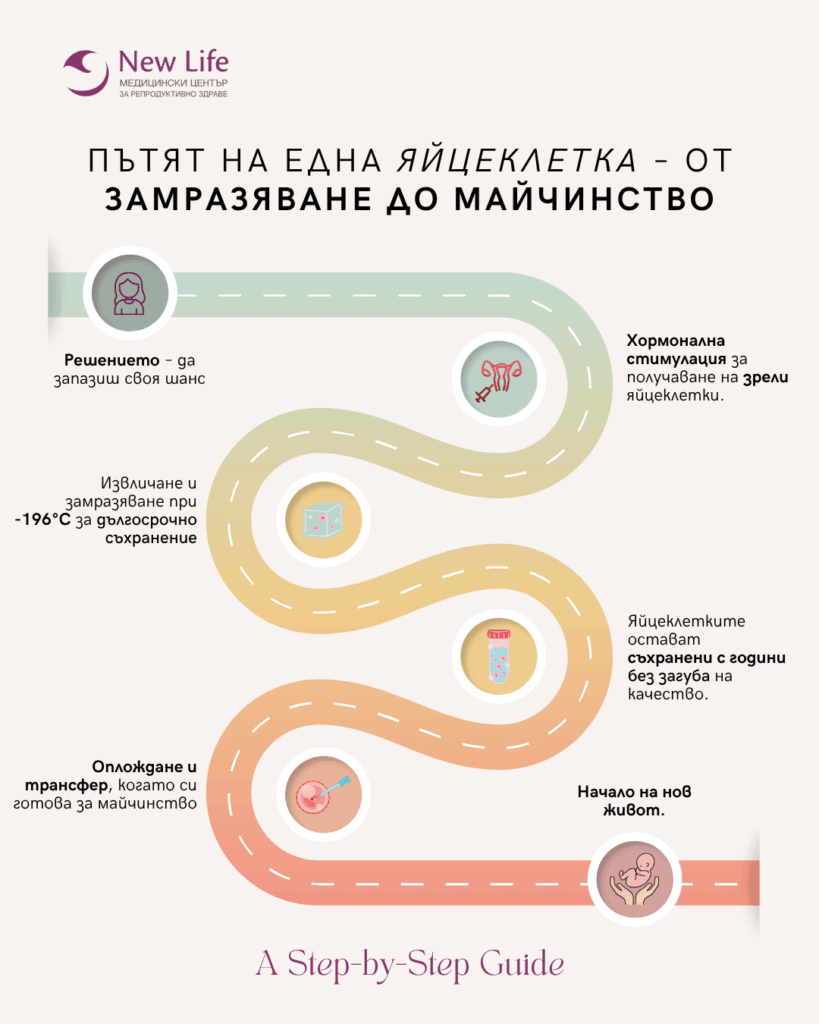
The procedure goes through several consecutive stages:
Preliminary tests and consultation
The first step is a meeting with an obstetrician-gynecologist experienced in reproductive medicine. During the consultation, your health, fertility, and goals are discussed. Necessary hormonal and ultrasound tests are prescribed to assess your ovarian reserve. At our clinic, scheduling an appointment is quick and easy – if desired, you can be seen as early as the next day.
Ovarian hormonal stimulation
After the consultation, hormonal therapy is initiated to stimulate the ovaries to produce more than one egg within a cycle. The stimulation lasts about 10 days and is administered through subcutaneous injections. The process is tailored individually and monitored through ultrasound and blood tests.
Egg retrieval – follicular aspiration
When the follicles reach the appropriate size, aspiration is performed – a minimally invasive procedure under short-term anesthesia. During this procedure, a thin needle is used to aspirate the mature eggs from the ovaries.
Freezing of viable eggs
The retrieved eggs are evaluated by an embryology team, and only those that are mature and suitable for fertilization are frozen using the vitrification method – a modern rapid-freezing technology that ensures high survival rates after thawing.
Agreement for storage/disposition of eggs
After the procedure, a contract is signed outlining the conditions for long-term storage. It includes information about your rights, storage duration, and potential actions regarding the future use or disposal of the eggs.
How the egg freezing process works
Egg freezing involves cooling the cells to extremely low temperatures, at which all biological activity ceases. To ensure safe and long-term preservation, the eggs are frozen at temperatures below -130°C using liquid nitrogen.
Before freezing, the eggs are treated with cryoprotectants—special substances that prevent the formation of ice crystals, which can damage the cell structure. Eggs are the largest cells in the human body and have a high water content, making them particularly sensitive to freezing—this is why the technology requires great precision and expertise.
If you are considering egg freezing and would like more information, our team is here to support you with an individual approach, care, and attention.
Why egg freezing requires specialized technology
Egg freezing is one of the most delicate and challenging procedures in reproductive medicine. This is because the egg is not an ordinary cell—it is the largest cell in the human body and contains a very high amount of intracellular water, which makes it especially vulnerable to damage during freezing.
The Physics of Freezing: Why Water Is a Problem
Water behaves in a unique way when cooled. Unlike most substances, it expands between 4°C and 0°C. During freezing, this water turns into ice crystals, which can tear the cell membranes and destroy the internal structure. This is the primary challenge in freezing eggs—preventing the formation of ice crystals inside the cell, which would render it unsuitable for fertilization in the future.
The History of egg freezing: Where it all began
The first attempts to freeze human eggs date back to the late 20th century, but the procedure was not routinely applied for a long time due to the high sensitivity of oocytes and their low survival rates after thawing. The first successful birth from a frozen and thawed egg was documented in 1986, but it took decades for the technology to evolve to a clinically reliable level.
Vitrification – the technological breakthrough in egg freezing
A true revolution in the field came with the development of vitrification—an ultra-rapid freezing technique. Unlike traditional slow freezing, vitrification uses very high concentrations of cryoprotectants (substances that protect cell structures) and extremely fast cooling rates—over 20,000°C per minute. This prevents the formation of ice crystals inside the cell, transforming the water content into a glass-like, non-crystalline state that preserves the egg’s integrity.
What is the success rate of egg vitrification?
Thanks to vitrification, today’s egg survival rate after thawing reaches 90% or more. This makes the procedure comparable in success to using fresh eggs in IVF cycles. The risk of chromosomal damage is also minimized, which is crucial for successful fertilization and healthy embryo development.
Egg freezing today: A recognized and effective method
Today, vitrification is a standardized and widely used method in leading fertility clinics worldwide. Several international medical organizations, including the American Society for Reproductive Medicine (ASRM) and the European Society of Human Reproduction and Embryology (ESHRE), officially recognize egg freezing as a reliable and safe method for fertility preservation—not only for medical but also for social reasons.
Vitrification: The gold standard in egg preservation
Despite the tremendous progress, vitrification remains a highly specialized procedure requiring: precision techniques and state-of-the-art equipment; an experienced embryology team trained in vitrification protocols; strict laboratory conditions for freezing and storage; high-level coordination between lab and clinical teams. Only when all these conditions are met can high survival rates of oocytes and a real chance for future pregnancy after thawing be ensured.
Egg freezing is not just freezing – it is a high-tech process, the result of decades of research and clinical experience. Thanks to the method of vitrification, women today have the opportunity to preserve their eggs in their best biological state, thus maintaining their chance for biological motherhood when they decide the time is right.
Reasons for egg freezing
Social egg freezing allows you to postpone motherhood without losing your chances of having a biological child. The most common social reasons include:
- Lack of a suitable partner or a current partner who is not yet ready for parenthood.
- Focus on education, career development, or personal growth.
- Desire to delay a second pregnancy to a later stage in life.
- Pursuit of personal goals or dreams you wish to achieve before starting a family.
- Ethical or religious beliefs that do not permit embryo freezing during an IVF procedure.
Medical reasons and egg freezing before oncotherapy
Egg freezing may also be necessary for medical reasons. Such cases include:
- A hereditary predisposition to early menopause
- Diagnosed conditions like endometriosis or autoimmune diseases that may affect ovarian function
- Previous ovarian surgeries or the presence of ovarian cysts and tumors